Another experiment with the video blog. No local, state, or federal laws were broken during the filming of this video. 🙂
Another experiment with the video blog. No local, state, or federal laws were broken during the filming of this video. 🙂
 Is it winter? Upstate New York just received more than 2 inches of rain in the month of January! What’s up with that? It’s winter, not spring. Since I am a snow lover, I thought one of the benefits of being a pastor in upstate New York was the snow. Where is it!?! My dreams of snowmobiling, skiing, and snowshoeing are quickly becoming just that, a dream. This is not the winter season I had hoped for. The weather we have had lately has been more of a Washington D.C. winter: rainy, some snow, sometimes mild, or sometimes cold. You never know what you will get. Then, just this week, we received a foot of snow. What a crazy winter!
We all know that we have four seasons of weather, but often we do not realize that we go through spiritual seasons. Unlike winter, spring, summer, and fall, spiritual seasons do not begin and end in a timely fashion. Rather, we experience highs and lows with our relationship with God that correspond to our life situations. During high spiritual seasons, we feel on fire for God, have a sense of excitement, and feel the need to reach out to someone. During “low” spiritual seasons, we wonder why we feel so discounted, out of place, or have feelings of doubt. We long for support, understanding, and love.
A new feature for all your Bema readers: a video blog post. Some thoughts on Lent, Jonah, a new preaching series, and Joan of Arc. Enjoy. You can also watch it in HD.
Lent 1c


Huh? A Baptist who celebrates Ash Wednesday? That’s like an American celebrating Boxing Day. The two just don’t go together.
Despite the misnomer, Baptists do celebrate Ash Wednesday and Lent, especially this Baptist. Two of the classic Baptist distinctives is local autonomy and soul liberty. Each Baptist church has the freedom to worship however the church sees fit. Since we Baptists do not have a book of worship or order, like other denominations, Baptists are free to worship as they feel led. This, of course, does not happen in a vacuum. I have always believed that Baptists must be led by scripture, reason, tradition, and experience (the Wesleyan Quadrilateral) with scripture being the final authority.
Ash Wednesday marks the first day of Lent. The goal of Ash Wednesday is to reflect upon our humanness, our need for forgiveness, and our connection to Christ’s last days. These themes are symbolized by the imposition of ashes on the forehead, with the words, “You are dust and to dust you shall return…” during the worship service. In the Old Testament, ashes were a sign of penitence and mourning. Job was known for placing ashes upon his head to mourn the loss of his family.
Sure, Catholics do it, but that does not mean that we become Catholic if we receive ashes. We are merely participating in the greater historical liturgical practices of Christians. There is nothing magical about the ashes. You are not any more holy for participating in Ash Wednesday, but it is just another way to experience the presence of God in our lives in a symbolic way.
But, where did this act of worship and repentance on Ash Wednesday come from? Christianity Today provides some insight:
I started using Facebook.com shortly after I entered graduate school in  2003. Facebook is a social networking internet webpage that connects people, organizations, families, and business. Some of my college friends began to use Facebook and I saw it as a way to stay in touch with people. Facebook was confusing. Why I could see everyone’s business: who they talked to, what they posted, what they said, etc… Now, Facebook is ubiquitous. My parents, who are retired, even have a Facebook page!
Facebook is a great way to connect, but have we replaced Facebook with true “facetime?” Have we replaced what we would do with our friends and family with what we should do in person? Have we lost a sense of personal touch with the use of Facebook? A social networking website cannot replace what we experience in real life.
In our scriptures for Sunday, so much is made about “facetime” with God. In the Old Testament lesson, Moses is face to face with God. After the experience, Moses’ face changes. Moses puts a veil over his face to hide it from the Israelites. In our Gospel text, Jesus’ face and complexion change during the Transfiguration.
Why all this attention to the Transfiguration? The Transfiguration is important and Darrell Jodock in the Christian Century explains why:
In a reverse this year, the big game was actually more interesting than the commercials. New Orleans pulled off a win! As I watched the Super Bowl commercials, I caught Focus on the Family’s paid ad featuring Tim Tebow and his mother. There was no mention of “abortion”, “the doctors told me”, or even “God.” If you missed the commercial here it is:
What is so discouraging is the inflated hype around this commercial. Nobody previewed it, nobody knew what was going to be said, and no one saw a script of the commercial. Yet, anti-religious and anti-abortion pundits were quick to condemn Tebow, Focus on the Family, and CBS.
Though I do not always agree with Focus on the Family’s approach or James Dobson’s sentiments, I do believe this Super Bowl ad was the right approach for their message. If you want to pay 2.5 million dollars you have the right to proclaim a message, sell a product, or make a statement. It was a personal story of joy about a mother and son and their life together.
Rowland Martin, CNN political analyst, made some good points when he wrote:
 The following is an article I wrote for the “Voices of Faith” column which appeared in Saturday’s Times Union:
I remember watching the pregame coverage of Super Bowl XXXII in 1998 and being shocked when a reporter asked Green Bay Packers’ defensive end and ordained minister Reggie White if he thought God wanted him to win the Super Bowl. White shot back, “Well, I’m praying to win.” The reporter replied, “Do you think the Broncos are praying to win too?” “I’m sure they are,” White said. Then the reporter asked this bombshell: “If you are praying that Green Bay wins, and the Broncos are praying to win, then who does God want to win?”
With this year’s big game set for Sunday, it seems that God and football have been the hot topic lately. Quarterback Kurt Warner, who’s got a Super Bowl ring of his own, retired last week after saying he was seeking divine guidance to help him decide. Heisman Trophy winner Tim Tebow has been criticized for appearing in an ad to be aired during the game paid for by Focus on the Family that promotes the Christian organization’s pro-life stance. Tebow is also known for biblical references to “John 3:16” and “Phil 4:13″ on the eye black strips he uses to cut glare.” Tony Dungy, a Super Bowl champion coach and author of The New York Times best-seller, “Uncommon,” has attributed his success to Jesus Christ.
According to the NFL, 87 percent of its players come from some sort of “Protestant background.” Every team in the league offers its members Bible study groups, chapel or worship services. Athletes in Action, a division of Campus Crusade for Christ, provides chaplains for numerous NFL teams. Tom Krattenmaker, in his book “Onward Christian Athletes: Turning Ballparks into Pulpits and Players into Preachers,” makes the case that public displays of faith are not spontaneous, but rather part of a large Christian presence in the professional ranks.
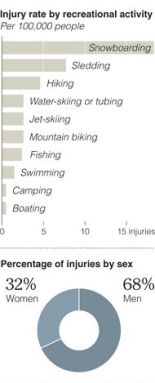 Believe it or not, but we all take risks. We take a risk every time we drive, go to the store, or eat dinner at a restaurant. When we drive, there is a risk of an accident. When we go to the store, there is a risk that we could slip and fall on spilled milk in isle 8. At a restaurant, there is a risk of eating contaminated food and getting sick.
Some risks are bigger than others. Football, skiing, snowmobiling, ski diving, and racing are all risky activities. Men are responsible for 68% of all injuries, while women only 32%. Young people under the age of 24 account for a third of all injuries. Unfortunately, for me, these statistics ring true for me, but that’s another story.
Insurance companies make money by discriminating people based on age, sex, and past medical history to account for the likelihood of accidents, medical procedures, or injury. Financial companies charge people more money for loans if they are deemed more likely to default on a loan. The bigger the risk, bigger the potential reward or loss. Millions of dollars are invested in “venture capital” projects that could either fail or make a ton of money.
Risk is big business… I guess you can say a risky business.


You must be logged in to post a comment.